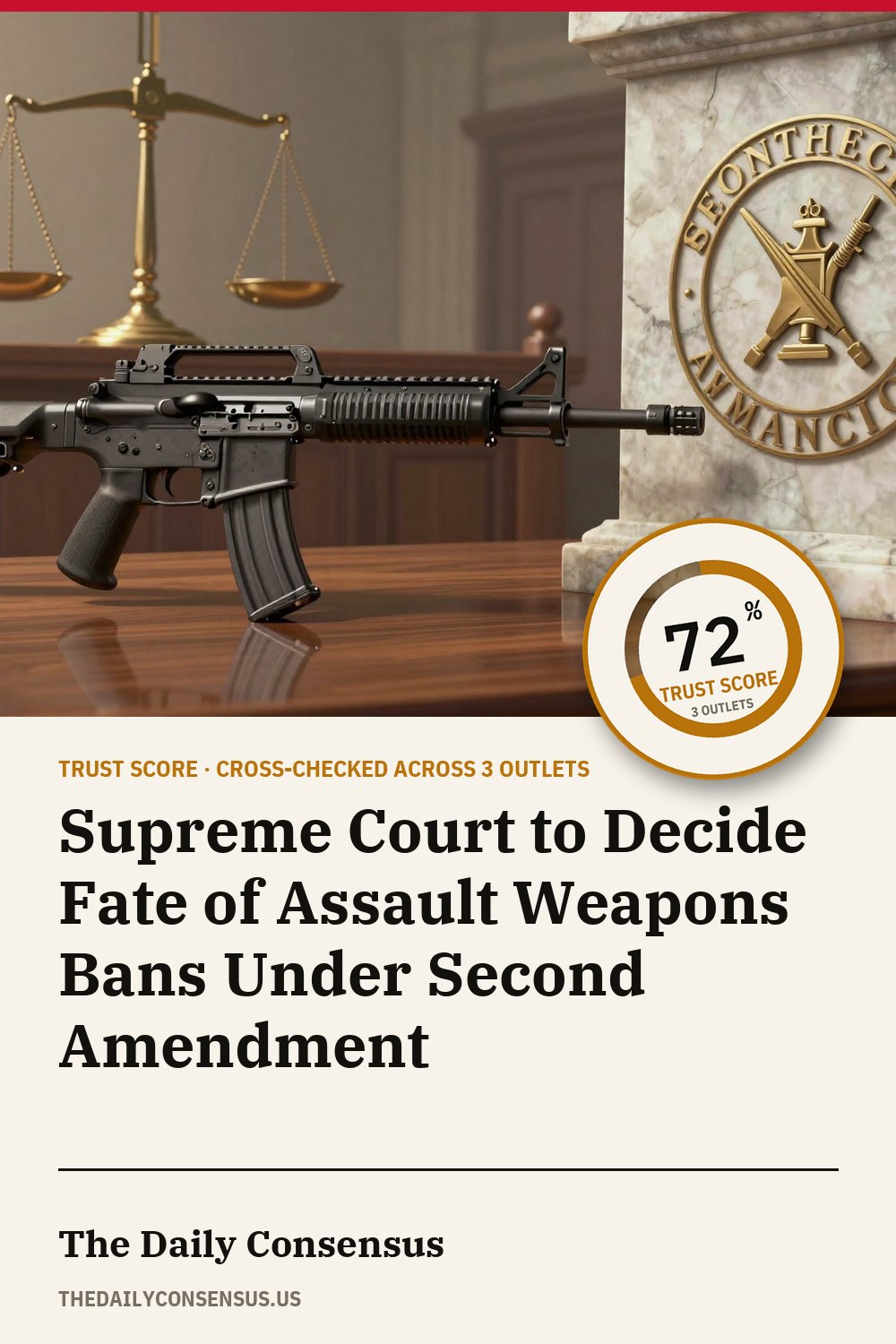
Supreme Court to Decide Fate of Assault Weapons Bans Under Second Amendment
The U.S. Supreme Court is set to review the constitutionality of bans on AR-15 and similar firearms, potentially reshaping gun laws nationwide.

The U.S. Supreme Court is set to review the constitutionality of bans on AR-15 and similar firearms, potentially reshaping gun laws nationwide. This landmark case, which involves challenges to bans in Cook County, Illinois, and Connecticut, is scheduled to hear oral arguments on December 2, 2026. At stake is the interpretation of the Second Amendment and whether it protects the right to possess these types of weapons.
Nicole Hockley, whose six-year-old son Dylan was tragically killed in a shooting involving an AR-15 style rifle, has become a prominent advocate for assault weapons bans. Her personal connection to the issue adds emotional weight to the legal debate over the constitutionality of such bans. Cook County, Illinois, implemented a ban on certain firearms, including the AR-15 and AK-47, following a 1989 shooting incident, illustrating how local tragedies can influence broader policy changes.
Cook County argues that AR-15 and similar weapons are designed for maximum lethality and are not typically used for self-defense, distinguishing them from other firearms. This characterization is crucial as it forms part of the legal argument that these weapons should not be protected under the Second Amendment. However, gun rights supporters counter that banning the AR-15 is unconstitutional, emphasizing its widespread use and popularity among American gun owners.
Federal appeals courts have issued conflicting decisions about the constitutionality of the bans, with most upholding the restrictions. This divergence highlights the complexity of the legal landscape surrounding the Second Amendment and the potential for significant impact from the Supreme Court’s ruling. Democratic state attorneys general in 18 states support rejecting arguments that AR-15 and similar firearms should be protected due to their popularity, further emphasizing the political stakes of this legal battle.
Approximately 25% of gun owners own an AR-15-type rifle, and 30% own at least one rifle commonly referred to as an 'assault weapon', making these firearms a central part of the American gun culture. The AR-15 is the second most popular firearm after semiautomatic handguns, underscoring its significance in both civilian ownership and public discourse. High-profile mass shootings often involve semiautomatic rifles, contributing to the ongoing debate about their role in public safety.
Americans own an estimated 40 million AR-15 type rifles, reflecting the widespread ownership and cultural importance of these weapons. The Supreme Court's decision could have far-reaching implications for other gun laws, potentially setting a precedent for future legal challenges. Connecticut and Illinois argue that AR-15s pose an unacceptable threat to human life, highlighting the safety concerns that drive the push for bans on these weapons.
What We Know
- The Supreme Court is reviewing if assault weapons bans go against the Second Amendment. 123
- Nicole Hockley lost her six-year-old son Dylan in a shooting incident involving an AR-15 style rifle. 1
- Cook County, Illinois, banned certain firearms such as the AR-15 and AK-47 following a 1989 shooting incident. 2
- The U.S. Supreme Court is scheduled to hear oral arguments on December 2, 2026, regarding the constitutionality of bans on AR-15 and similar firearms. 2
- The case involves challenges to bans in Cook County, Illinois, and Connecticut. 2
- Eleven states and the District of Columbia have bans on 'assault weapons'. 2
- Approximately 25% of gun owners own an AR-15-type rifle, and 30% own at least one rifle commonly referred to as an 'assault weapon'. 2
- Cook County argues that AR-15 and similar weapons are offensive weapons of war designed for maximum lethality and not typically used for self-defense. 2
- Federal appeals courts have issued conflicting decisions about the constitutionality of the bans, with most upholding the restrictions. 2
- Democratic state attorneys general in 18 states support rejecting arguments that AR-15 and similar firearms should be protected due to their popularity. 2
- Nicole Hockley supports the assault weapons ban. 3
- Gun rights supporters argue that banning the AR-15 is unconstitutional. 3
- Approximately a dozen states have similar laws banning weapons like the AR-15. 3
- AR-15 type weapons are the second most popular after semiautomatic handguns. 3
- Several high-profile mass shootings involved semiautomatic rifles. 3
- Handguns are more prevalent in overall gun violence and mass shootings. 3
- The Supreme Court's decision could affect other gun laws. 3
- Americans own an estimated 40 million AR-15 type rifles. 3
- Connecticut and Illinois argue that AR-15s pose an unacceptable threat to human life. 3
Powered by Quantum Forge Robotics with Jessi AI Intelligence
Trust Score report
- confirmed
The Supreme Court is reviewing if assault weapons bans go against the Second Amendment.
87% · supported by 3 - likely
Nicole Hockley lost her six-year-old son Dylan in a shooting incident involving an AR-15 style rifle.
72% · supported by 1 - likely
Cook County, Illinois, banned certain firearms such as the AR-15 and AK-47 following a 1989 shooting incident.
72% · supported by 1 - likely
The U.S. Supreme Court is scheduled to hear oral arguments on December 2, 2026, regarding the constitutionality of bans on AR-15 and similar firearms.
72% · supported by 1 - likely
The case involves challenges to bans in Cook County, Illinois, and Connecticut.
72% · supported by 1 - likely
Eleven states and the District of Columbia have bans on 'assault weapons'.
72% · supported by 1 - likely
Approximately 25% of gun owners own an AR-15-type rifle, and 30% own at least one rifle commonly referred to as an 'assault weapon'.
72% · supported by 1 - likely
Cook County argues that AR-15 and similar weapons are offensive weapons of war designed for maximum lethality and not typically used for self-defense.
72% · supported by 1 - likely
Federal appeals courts have issued conflicting decisions about the constitutionality of the bans, with most upholding the restrictions.
72% · supported by 1 - likely
Democratic state attorneys general in 18 states support rejecting arguments that AR-15 and similar firearms should be protected due to their popularity.
72% · supported by 1 - likely
Nicole Hockley, a mother whose son died in the Sandy Hook shooting, supports the assault weapons ban.
71% · supported by 1 - likely
Gun rights supporters argue that banning the AR-15 is unconstitutional.
71% · supported by 1 - likely
Approximately a dozen states have similar laws banning weapons like the AR-15.
71% · supported by 1 - likely
AR-15 type weapons are the second most popular after semiautomatic handguns.
71% · supported by 1 - likely
Several high-profile mass shootings involved semiautomatic rifles.
71% · supported by 1 - likely
Handguns are more prevalent in overall gun violence and mass shootings.
71% · supported by 1 - likely
The Supreme Court's decision could affect other gun laws.
71% · supported by 1 - likely
Americans own an estimated 40 million AR-15 type rifles.
71% · supported by 1 - likely
Connecticut and Illinois argue that AR-15s pose an unacceptable threat to human life.
71% · supported by 1
Sources & references
- PBS NewsHour — The Supreme Court will decide whether assault weapons bans violate the Second Amendment
- Stateline — US Supreme Court to weigh bans on AR-15s, similar guns in big Second Amendment case
- ABC News U.S. — The Supreme Court will decide whether assault weapons bans violate the Second Amendment