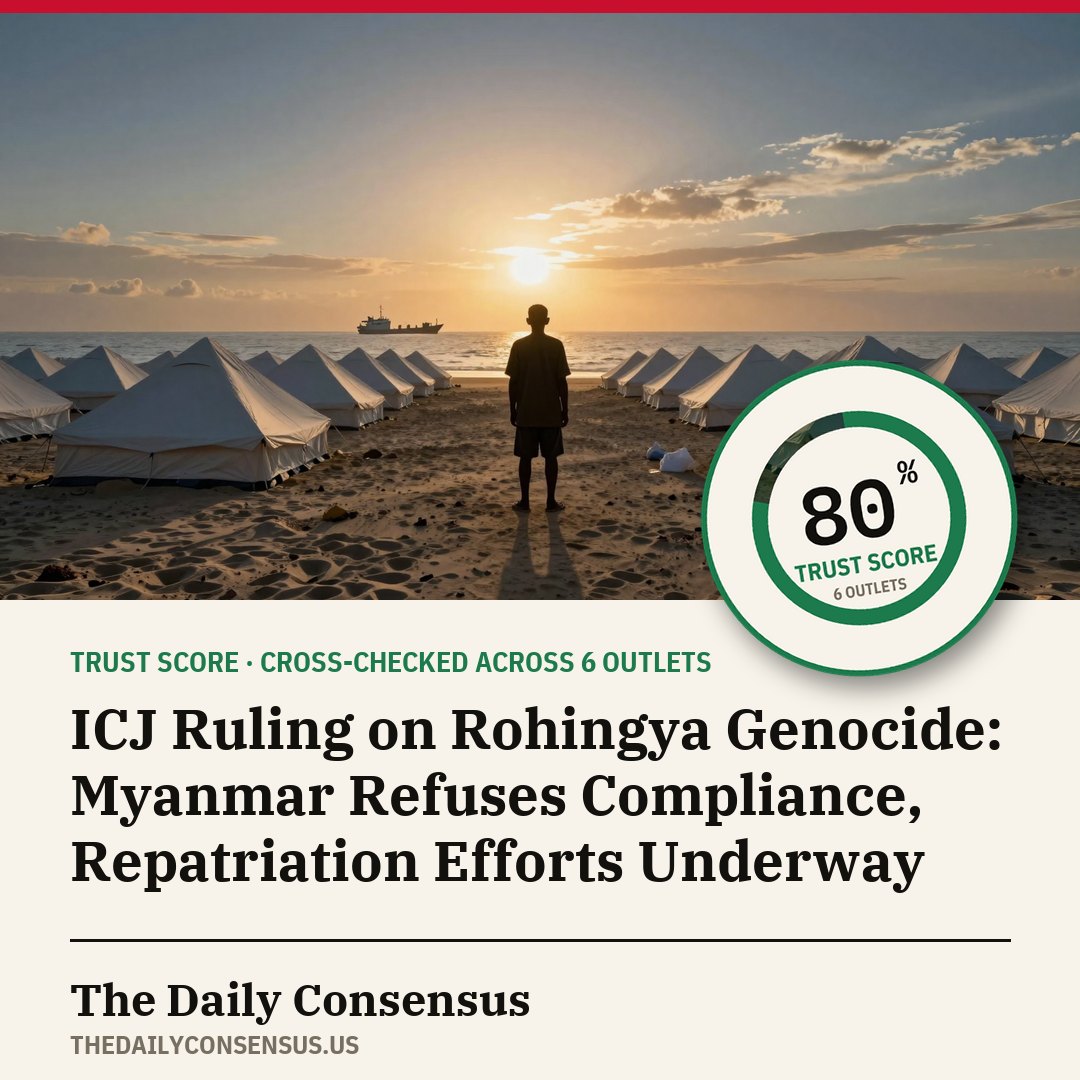
ICJ Ruling on Rohingya Genocide: Myanmar Refuses Compliance, Repatriation Efforts Underway
The International Court of Justice (ICJ) has ruled that Myanmar committed genocide against the Rohingya, but the country's leader, Min Aung Hlaing, has stated non-compliance with certain aspects of the decision.

The International Court of Justice (ICJ) has handed down a significant ruling, confirming that Myanmar committed genocide against the Rohingya minority in 2017 12456. This landmark decision comes after years of international scrutiny and advocacy for justice for the persecuted group. However, the ruling stops short of mandating citizenship for all members of the Rohingya community, leaving some key questions unresolved.
Approximately 10,000 Rohingya were violently killed during the 2017 military crackdown, and over 700,000 fled to Bangladesh, marking a devastating humanitarian crisis 15. The ICJ has ordered Myanmar to pay reparations and cease ongoing violations, though the exact amount of these reparations remains unspecified 15.
Myanmar’s leader, Min Aung Hlaing, has expressed his intention to not comply with certain parts of the ICJ’s ruling, indicating a potential challenge to the implementation of the court’s directives 1. This stance highlights the complexity of enforcing international legal judgments on sovereign states, especially in cases involving significant domestic political and social issues.
In addition to the ICJ’s ruling, other notable developments include Malaysia’s plan to send thousands of migrants and refugees back to Myanmar 2. This move is part of broader efforts to address the refugee situation in Southeast Asia, where around 190,000 Myanmar refugees and asylum seekers reside, with the Rohingya making up roughly two-thirds of this population 2.
Three naval ships will return 1,500 people in December, and an additional 5,303 individuals will be flown back by aircraft at the expense of the Myanmar government 2. However, the United Nations has urged Malaysia to halt these repatriation efforts, citing the severe conditions in Myanmar as a reason for concern 2.
The UK has also taken action, imposing sanctions on several senior Myanmar military leaders following the ICJ’s ruling 1. This demonstrates the international community’s willingness to use economic and diplomatic pressure to influence Myanmar’s compliance with international law.
The ICJ’s ruling was made by a majority of nine votes to six, reflecting a close but decisive outcome 1. Over a dozen countries have recognized the ICJ’s ruling, underscoring its significance on the global stage 1.
What We Know
- The ICJ ruled that Myanmar committed genocide against the Rohingya minority in 2017 12456
- Approximately 10,000 Rohingya were violently killed, and over 700,000 fled to Bangladesh 15
- The ICJ ordered Myanmar to pay reparations and stop ongoing violations, but did not specify the amount 15
- Myanmar’s leader, Min Aung Hlaing, stated non-compliance with certain parts of the ICJ’s ruling 1
- Malaysia plans to send thousands of migrants and refugees back to Myanmar 2
- The UN urged Malaysia to stop repatriation efforts due to the severity of the situation in Myanmar 2
- The UK imposed sanctions on several senior Myanmar military leaders following the ICJ’s ruling 1
What Remains Unclear
- The exact amount of reparations to be paid by Myanmar
- Whether Malaysia will heed the UN’s call to stop repatriation efforts
- How many Rohingya will ultimately be able to return to their homes in Myanmar
Powered by Quantum Forge Robotics with Jessi AI Intelligence
Trust Score report
- confirmed
The ICJ ruled that Myanmar committed genocide against the Rohingya minority in 2017.
97% · supported by 5 - likely
Myanmar's leader, Min Aung Hlaing, stated that the country will not comply with certain parts of the ICJ's genocide ruling.
73% · supported by 1 - confirmed
Approximately 10,000 Rohingya were violently killed during the 2017 military crackdown, and over 700,000 fled to Bangladesh.
87% · supported by 2 - confirmed
The ICJ ordered Myanmar to pay reparations and to stop ongoing violations, but did not specify the amount of reparations.
87% · supported by 2 - confirmed
About 700,000 mostly Muslim Rohingya fled to Bangladesh due to a military campaign in Myanmar between 2016 and 2017.
87% · supported by 2 - likely
Malaysia plans to send thousands of migrants and refugees back to Myanmar.
72% · supported by 1 - likely
The ICJ's ruling was made by a majority of nine votes to six.
73% · supported by 1 - likely
Over a dozen countries have recognized the ICJ's ruling.
73% · supported by 1 - likely
The UK has imposed sanctions on several senior Myanmar military leaders following the ICJ's ruling.
73% · supported by 1 - likely
Rohingya make up approximately two-thirds of the 190,000 Myanmar refugees and asylum seekers in Malaysia.
72% · supported by 1 - likely
Three naval ships will return 1,500 people in December, and an additional 5,303 people will be flown back by aircraft at the expense of the Myanmar government.
72% · supported by 1 - likely
The UN urged Malaysia to stop the repatriation, stating that nobody should be deported to Myanmar due to the severity of the situation there.
72% · supported by 1
Sources & references
- BBC News — Myanmar refuses to comply with parts of ICJ genocide ruling
- The Guardian Asia Pacific — Malaysia to send thousands of migrants back to Myanmar as PM acknowledges junta’s ‘atrocities’
- The New York Times — A Landmark Genocide Ruling
- PBS NewsHour — Rights groups urge sanctions after ICJ finds Myanmar guilty of genocide against Rohingya
- Deutsche Welle — Myanmar genocide ruling: Rohingya say struggle for justice not over
- NPR — Myanmar committed genocide against its Rohingya Muslim minority, court rules