Unusual Affection Between Bull and Donkey Captivates Researchers
A bull and a donkey have formed a unique bond, exhibiting affectionate and sexual behaviors towards each other, sparking interest among scientists.
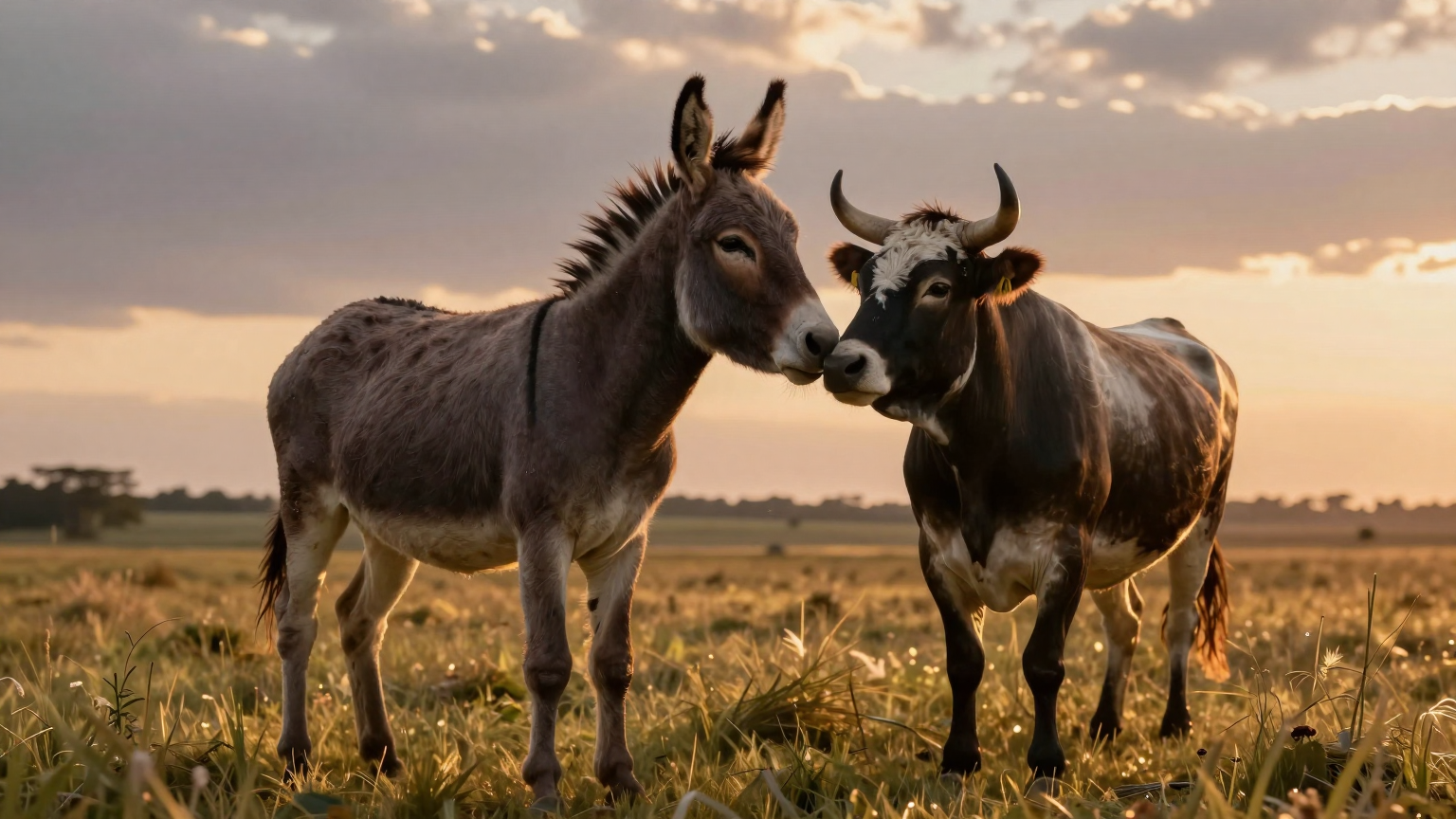
A remarkable display of interspecies affection has been observed between a bull named Achille and a donkey named Patroclo, captivating researchers and animal lovers alike. According to reports, these two animals have engaged in a series of behaviors typically associated with romantic and sexual relationships, including mounting, licking, and rubbing against each other. This unusual pairing has been documented over a period of thirteen days, from March 6 to March 19, 2026, during which time there were fifty-one recorded instances of Achille mounting Patroclo 12.
The relationship between Achille and Patroclo appears to be a voluntary one, with no signs of force or coercion noted by observers. Additionally, while other donkeys in the vicinity exhibited threatening behavior towards Achille, Patroclo did not, suggesting a special bond between the two 1. Interestingly, despite the bull's apparent fondness for his donkey companion, he also displayed typical courtship behaviors towards female cattle, indicating that his affections were not exclusive 1.
This unique pairing has taken place on an Ethiopian plateau, adding geographical intrigue to the story. However, the exact location within Ethiopia remains unverified, leaving some room for speculation about the specific environment where these interactions took place 2. Furthermore, while Achille showed a preference for Patroclo, he only attempted to mount another male donkey twice, which resulted in avoidance behaviors from the other donkey, highlighting the particular nature of his bond with Patroclo 2.
The significance of this discovery lies not just in the novelty of the relationship, but also in what it might tell us about the social and emotional lives of these animals. It challenges our understanding of typical animal behavior and could provide valuable insights into the complex social dynamics and preferences of bulls and donkeys 12.
What we know
- - A bull named Achille and a donkey named Patroclo exhibit affectionate and sexual behaviors towards each other 12
- - There were 51 instances of Achille mounting Patroclo from March 6 to March 19, 2026 12
- - The interactions include behaviors such as licking, rubbing, and mounting 12
- - Other donkeys show threatening behavior towards Achille, but Patroclo does not 1
- - The relationship appears to be voluntary and not forced 1
- - The bull and donkey belong to different owners 12
- - Achille showed courtship behaviors towards female cattle 1
- - The bond occurred on an Ethiopian plateau 2
- - Achille mounted another male donkey only twice, resulting in avoidance behaviors 2
What remains unclear
- - The exact location within Ethiopia where the bond occurred is unverified 2
Verification report
Likely accurate — probability of truth 76%, weighted across 10 claims from 2 independent outlets.
- confirmed A bull named Achille and a donkey named Patroclo exhibit affectionate and sexual behaviors towards each other. (86%)
- confirmed From March 6 to March 19, 2026, there were 51 instances of Achille mounting Patroclo. (86%)
- confirmed The interactions between Achille and Patroclo include behaviors such as licking, rubbing, and mounting. (86%)
- likely Other donkeys show threatening behavior towards Achille, but Patroclo does not. (72%)
- likely The relationship between Achille and Patroclo appears to be voluntary and not forced. (72%)
- unverified The study was conducted over eight days, with observations made when both animals were present and when only one was present. (51%)
- confirmed The bull and donkey belong to different owners. (86%)
- likely Achille showed courtship behaviors towards female cattle. (72%)
- likely The bull and donkey's bond occurred on an Ethiopian plateau. (71%)
- likely Achille mounted another male donkey only twice, which resulted in avoidance behaviors from the other donkey. (71%)
Sources
- The Guardian Environment — ‘It’s really, really unusual’: tender bond between male donkey and bull baffles scientists
https://www.theguardian.com/science/2026/nov/02/tender-bond-male-donkey-bull-baffles-scientists - Phys.org — An unusual sexual bond between a bull and a male donkey
https://phys.org/news/2026-10-unusual-sexual-bond-bull-male.html