Scientists Deploy Drones and Poop-Sniffing Dogs to Assess Health of Endangered Orcas
A unique approach combining aerial technology and canine assistance helps researchers gather vital data on the Southern Resident killer whales.
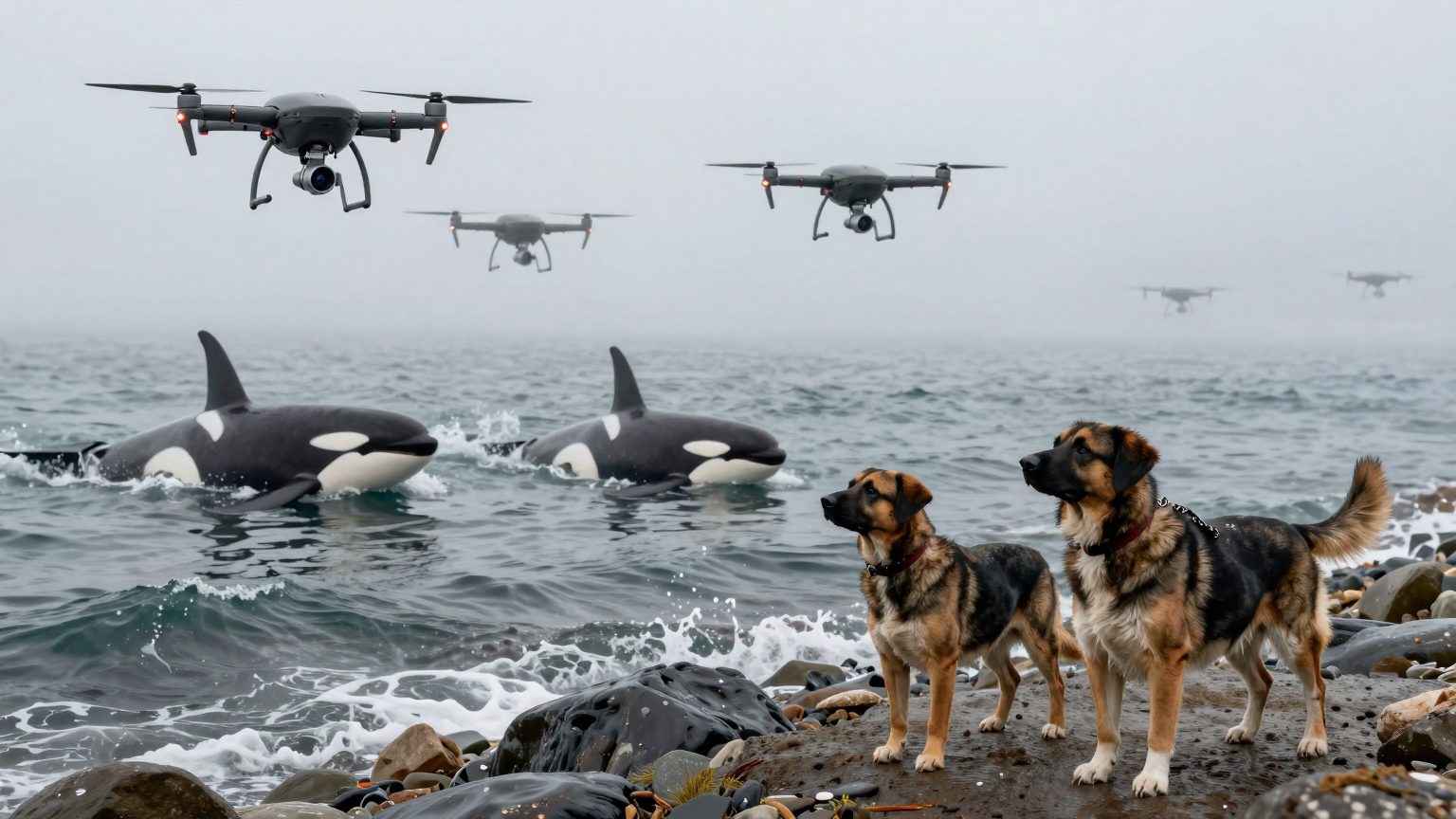
Scientists have employed an innovative method to monitor the health of endangered Southern Resident killer whales, utilizing both a drone and a specially trained dog to collect essential biological samples. This dual approach allows researchers to gather detailed information about the orcas' wellbeing, despite challenges posed by changing hunting habits and reduced food availability.
The Southern Resident killer whales, known for their distinctive black-and-white markings and complex social structures, currently number 76 individuals, making them critically important to study and protect. Traditionally, these orcas have relied heavily on Chinook salmon as their primary food source, but recent declines in the size and abundance of Chinook due to human activities have forced the orcas to adapt. They now hunt coho and chum salmon near Seattle, deviating from their usual hunting grounds in the Salish Sea.
To obtain accurate health assessments, researchers use a drone to capture droplets from the whales’ spouts, while a dog named Eba assists in locating and collecting stool samples. These samples provide critical insights into the orcas' health, offering hormonal, bacterial, fungal, parasitic, and DNA information. Such data is crucial for understanding the broader ecological impacts on the orcas and informing conservation efforts.
The Southern Residents face significant challenges, including a high rate of miscarriages among females and a notable calf mortality rate. In contrast, Bigg's killer whales, which primarily feed on marine mammals, are thriving. This disparity highlights the importance of restoring salmon populations to improve the Southern Residents' situation.
By tracking the orcas' movements and collecting these samples, researchers aim to gain a comprehensive view of the Southern Residents' health and the factors influencing their survival. This work underscores the interconnectedness of marine ecosystems and the impact of human activities on wildlife.
What we know
- Scientists use a drone and a poop-sniffing dog to conduct health checks on endangered orcas. 12
- The Southern Resident killer whales have a population of 76. 2
- The orcas hunt coho and chum salmon near Seattle instead of their usual area in the Salish Sea. 2
- Researchers collect droplets from whale spouts using drones and stool samples with a dog named Eba. 2
- Chinook salmon, the orcas' main prey, have decreased in size and abundance due to human activities. 2
- The orcas' hunting patterns have changed because of reduced food sources and increased human disturbance. 2
- Researchers track the orcas' movements to collect samples for health analysis. 2
- The collected samples provide hormonal, bacterial, fungal, parasitic, and DNA information. 2
- Many female orcas experience miscarriages, and there is a high calf mortality rate. 2
- Bigg's killer whales, which eat marine mammals, are thriving compared to the Southern Residents. 2
- Restoring salmon populations is crucial for improving the orcas' situation. 2
Trust Score report
Likely accurate — probability of truth 69%, weighted across 12 claims from 2 independent outlets.
- likely Scientists use a drone and a poop-sniffing dog to conduct health checks on endangered orcas. (72%)
- likely The Southern Resident killer whales are an endangered species with a population of 76. (71%)
- likely The orcas are hunting coho and chum salmon near Seattle instead of their usual area in the Salish Sea. (71%)
- likely Researchers collect droplets from whale spouts using drones and stool samples with a dog named Eba. (71%)
- likely Chinook salmon, the orcas' main prey, have decreased in size and abundance due to human activities. (71%)
- likely The orcas' hunting patterns have changed because of reduced food sources and increased human disturbance. (71%)
- likely Researchers track the orcas' movements to collect samples for health analysis. (71%)
- likely The collected samples provide hormonal, bacterial, fungal, parasitic, and DNA information. (71%)
- likely Many female orcas experience miscarriages, and there is a high calf mortality rate. (71%)
- likely Bigg's killer whales, which eat marine mammals, are thriving compared to the Southern Residents. (71%)
- likely Restoring salmon populations is crucial for improving the orcas' situation. (71%)
- unverified The orcas are spending less time in the Salish Sea due to searching for their decreasing food supply. (51%)
Sources
- PBS NewsHour — Using a drone and a poop-sniffing dog, scientists perform health checks on endangered orcas
https://www.pbs.org/newshour/science/using-a-drone-and-a-poop-sniffing-dog-scientists-perform-health-checks-on-endangered-orcas - Phys.org — Using a drone and a poop-sniffing dog, scientists perform health checks on endangered orcas
https://phys.org/news/2026-11-drone-poop-sniffing-dog-scientists.html